

WordPress Internal Linking for SEO: AI Automation
By AIFORYA — 22 June 2026 — 18 minutes read
On this page (11)
WordPress Internal Linking for SEO: AI Automation
Internal linking is one of the most strategic yet often underutilized levers in on-page SEO. A coherent and relevant internal link architecture effectively guides search engines, distributes authority ("link equity") throughout your content, and signals the thematic structure of your site. Beyond search engines, it significantly enriches the user experience, extending session duration and facilitating navigation to complementary information, which can ultimately increase conversions.
However, as a WordPress site grows in volume and complexity, the manual management of internal linking becomes a herculean task. It is not only extremely time-consuming but also inherently prone to omissions and inconsistencies. Orphan pages—important but isolated content—can emerge, while countless opportunities for semantically rich contextual links are inevitably missed. The full SEO potential of a site is thereby capped, for lack of adequate structural maintenance.
In today's digital landscape, marked by an explosion in content volume, the structure and semantic relevance of that content have become crucial differentiators. Smart internal linking is no longer just an asset but an indispensable strategic component. For professionals managing multiple WordPress sites—freelancers, small agencies, or CIOs of multi-site companies—the manual approach is no longer viable at scale. Fortunately, artificial intelligence (AI) provides powerful solutions to overcome these challenges.
This technical article explores in-depth how artificial intelligence is redefining internal linking strategy for WordPress platforms. You will discover:
- Why traditional linking methods have become obsolete in the face of the size and complexity of modern sites.
- The detailed technical workings of AI for analyzing content, identifying the most semantically relevant link opportunities, and suggesting optimized anchor texts.
- How a semi-automated approach, combining the power of AI with human judgment, allows for building and maintaining a robust internal linking structure with minimal effort.
Internal Linking: An SEO Pillar with Measurable Returns
Before exploring the innovations of automation, it is fundamental to reaffirm the central role of internal linking in any SEO strategy. Its impact is manifested on three critical axes that determine a site's success on search engines.
-
Optimizing Navigation for Search Engines: Internal links are the preferred paths that crawlers use to discover, index, and, most importantly, understand the hierarchy and structure of your site. A dense, logical, and well-organized linking structure ensures that all important pages are accessible, crawled, and not at risk of being ignored by search engines. It also facilitates the updating of the index for existing pages.
-
Strategic Distribution of Authority (PageRank): Each link transmits a share of authority from the source page to the destination page, a concept often referred to as "link equity." By strategically linking your most powerful or most visited content (your "pillar pages") to deeper but contextually relevant pages, you significantly strengthen their ability to rank for specific queries. It's an effective way to amplify the SEO strength of your entire content ecosystem.
-
Strengthening Context and Semantics: The anchor text of a link—the visible and clickable text—is a strong signal sent to Google about the main topic of the destination page. A precise linking structure, using varied and descriptive anchors, helps search engines build a rich and nuanced understanding of the thematic relationships between your different pieces of content. This consolidates your authority and relevance in targeted semantic niches, promoting better overall rankings.
A rigorously executed internal linking strategy can lead to a significant improvement in the visibility of deep pages, a notable increase in organic traffic, and a better understanding by search engines of the intrinsic value of your content. These benefits translate directly into performance and profitability metrics for any website.
The Limits of Traditional Approaches in the Age of Massive Content
In theory, the simplicity of internal linking is appealing; in practice, its management at scale is formidably complex. Conventional methods quickly reach their limits, especially for professionals who must manage a portfolio of multiple sites or a colossal volume of content.
-
Unsustainable Manual Management: For a site with more than fifty articles, trying to track all link opportunities in a spreadsheet, or even through an article-by-article review, quickly becomes unrealistic. The investment in time and human resources far exceeds the potential benefits, and the ability to maintain this consistency over the long term is virtually nil. Regular audits, though essential, become impossible to conduct with the necessary frequency.
-
Limited Keyword-Based Approaches: Many "related content" tools or plugins rely on simplistic lexical matches, tags, or categories. This approach often generates lists of relevant links, but they suffer from significant limitations. They are frequently displayed at the bottom of the page, where user engagement and SEO weight are lower. Most importantly, they fail to integrate contextual links within the text itself, where their semantic value is highest for search engines and where they most effectively guide users. These methods struggle to capture the deep semantic nuances that link conceptually similar but lexically distinct content.
-
Inconsistencies and Orphan Pages: Without an automated monitoring and suggestion system, maintaining link consistency is impossible. The addition of new "pillar" articles does not guarantee an update of links from relevant older content. Conversely, important articles can become progressively isolated over time, losing their visibility and becoming true "orphan pages" invisible to crawlers and users. This fragmentation severely harms the site's overall authority.
These limitations do not result from a lack of expertise or will, but rather from the absence of tools capable of managing the complexity, volume, and especially the semantic depth required for a high-performing internal linking structure on a modern website.
The AI Intervention: The Paradigm Shift for Internal Linking
Artificial intelligence, and more specifically the advancements in Natural Language Processing (NLP) and semantic embedding, offers a major technological breakthrough. Instead of being limited to raw lexical matching, AI is now able to "understand" the deep meaning and conceptual relationships within your content. This process, of unparalleled precision and scale, is broken down into several sophisticated technical steps.
Step 1: Indexing and Deep Semantic Analysis via Embeddings
The first stage of AI intervention consists of an exhaustive analysis of your entire published content. For each article, page, or text fragment, the system generates embeddings. These are numerical vector representations, points in a multidimensional space, where the proximity between two points reflects the semantic similarity of their corresponding texts.
These embeddings are typically generated using sophisticated pre-trained language models, often based on the Transformer architecture (like BERT, GPT, etc.). These models have learned to understand the context and meaning of words through enormous text corpora. Thus, two paragraphs discussing similar concepts—for example, one talking about "page load speed" and the other about "server response time"—will be represented by very close vectors in the embedding space, even if their exact wording differs. This ability to grasp the concept behind the words is what radically distinguishes the AI approach from a simple lexical analysis.
These semantic vectors are then stored in a vector database (like Pinecone, Weaviate, or Qdrant). These databases are specifically optimized to perform high-speed similarity searches in high-dimensional spaces, which is crucial for a site with hundreds, or even thousands, of pages.
Step 2: Identification of Precise Contextual Opportunities
Once this complete "semantic map" of your content is established, the AI can identify internal linking opportunities with surgical precision. The system scans all your texts in search of phrases, paragraphs, or key concepts that could benefit from a link to other relevant content on your site.
To do this, it performs a cosine similarity search between the embedding of each potential source text segment and the embeddings of all possible destination pages. Cosine similarity measures the angle between two vectors: a small angle indicates high semantic similarity.
- Concrete Example: Imagine a new article on "best WordPress security practices in 2026." The AI, by scanning all your old articles, identifies a paragraph in an older post that mentions "the importance of regularly updating plugins to avoid vulnerabilities." By calculating the cosine similarity between the embedding of this paragraph and the embedding of your new article on security, the AI determines that this is an extremely relevant link opportunity. This detection would be very difficult to perform manually for a large volume of content.
The AI doesn't just find obvious matches; it reveals deep, non-trivial connections that would escape human or lexical analysis.
Step 3: Suggestion of Optimized and Natural Anchor Texts
The AI goes beyond simply identifying the link's location; it is also capable of suggesting the most relevant and optimized anchor text for each opportunity. By leveraging its language generation capabilities, it analyzes both the immediate context of the phrase source and the content (title, meta-description, first paragraphs) of the destination page.
The mechanism may involve a quick query to a Large Language Model (LLM) or an intelligent extraction of key phrases. The goal is to propose anchors that are:
- Natural: Fluidly integrated into the text, avoiding a forced or robotic appearance.
- Informative: Giving a clear idea of the target page's content, for both the user and search engines.
- Varied: Avoiding the over-optimization of a single keyword, which could be penalized. The AI can propose several semantically similar phrasings to diversify the anchor text profile.
This ability to generate high-quality anchors ensures that each internal link maximizes its SEO impact while improving navigability for the user.
A Semi-Automated Approach: The Human at the Center of the Strategy
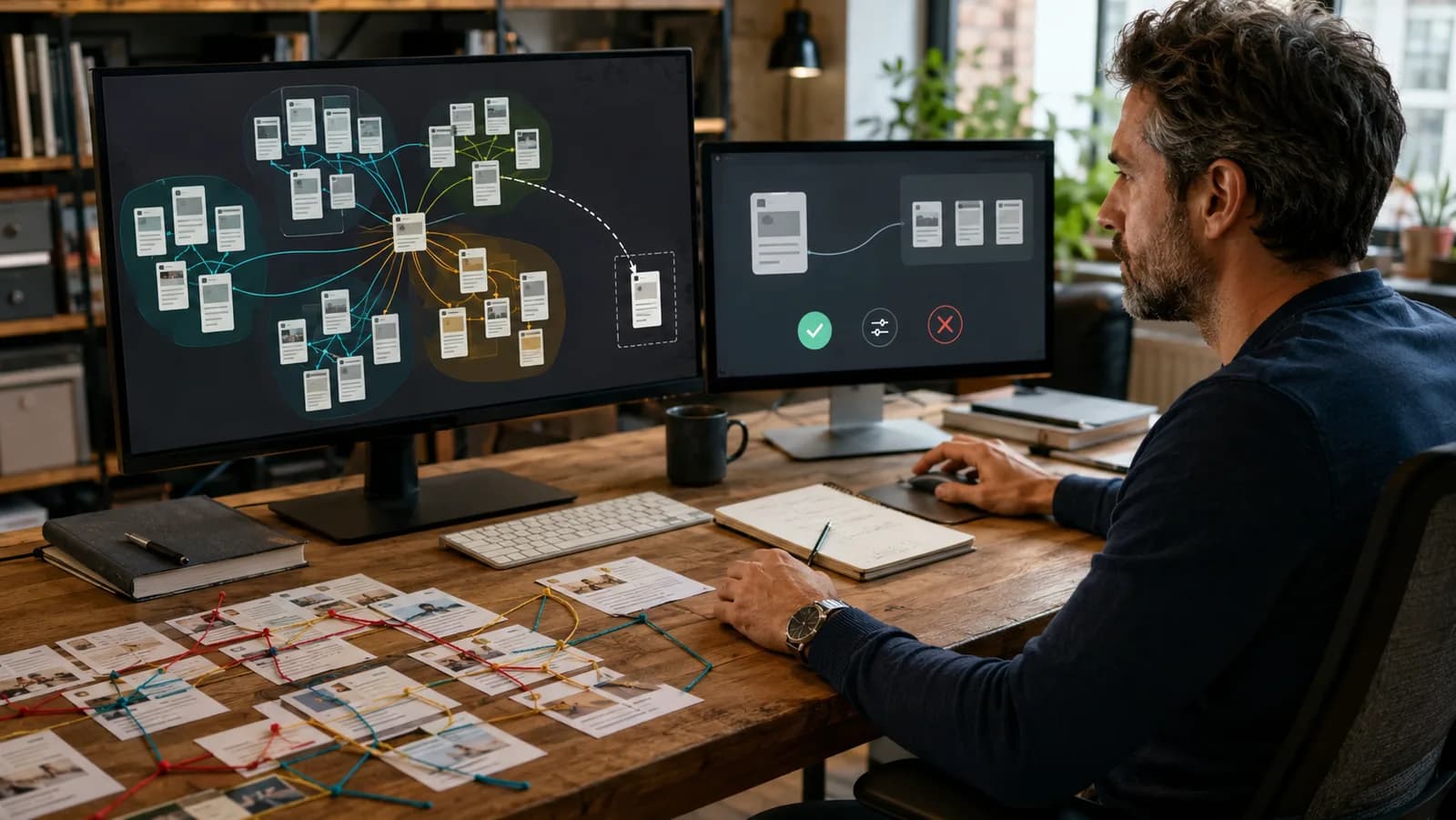
The goal of AI in internal linking is not to replace the human, but to multiply their capabilities. Full automation without supervision could occasionally generate relevant but contextually misplaced links, or miss strategic nuances. The most effective and safest approach is therefore semi-automated, where the analytical power of AI meets the editorial judgment of the SEO expert.
- Continuous Scan and Background Analysis: The AI operates autonomously, regularly scanning all content (new and existing) to identify a constant stream of qualified link opportunities. This process runs as a background task, without impacting site performance.
- Centralized and Intuitive Dashboard: The AI's suggestions are presented in a clear and ergonomic user interface. They are often ranked by a semantic relevance score, allowing the expert to prioritize reviews. Key information (source text, suggested anchor, destination page) is displayed for quick decision-making.
- Validation and Refinement by the Expert: The SEO professional reviews each suggestion. They have simple and quick options:
- Accept in one click: Inserts the link directly into the article.
- Edit: Allows for refining the anchor text or the exact placement of the link for perfect editorial integration.
- Reject: Discards the suggestion if it is not deemed relevant to the strategy.
- Learning from Feedback: The system is designed to learn from these interactions. The decisions (acceptances, edits, rejections) serve as feedback data. The AI can use this information, through a mechanism of reinforcement learning from human feedback or by enriching the training data, to refine its models and improve the quality of future recommendations. This allows for the progressive personalization of the tool to the editorial and strategic specifics of each site.
This optimized workflow transforms a tedious and time-consuming task into a strategic review of a few minutes per week. It not only ensures maximum quality and relevance of the internal linking but also represents a considerable productivity gain for freelancers and a powerful standardization tool for agencies managing multiple clients.
AIFORYA Internal Linking: Your AI SEO Assistant for WordPress
AIFORYA, anticipating this pressing need for efficiency and precision, has developed the AIFORYA Internal Linking plugin. This solution integrates this intelligent process directly into your WordPress dashboard, turning the chore of internal linking into a continuous strategic SEO advantage.
The AIFORYA Internal Linking plugin is specifically designed for web professionals who demand full editorial control combined with maximum efficiency. It condenses hours of manual searching for link opportunities into a few minutes of strategic validation. Instead of actively searching for the needle of opportunity in the haystack of your content, you receive a pre-qualified list of the best suggestions, ready to be integrated.
With AIFORYA Internal Linking, you remain the final strategist. The AI intelligently proposes, and you validate the final editorial decision. Each link suggestion can be accepted with a single click, edited for perfect refinement of the anchor text or positioning, or simply rejected. For agencies and managers of multiple sites, it's the assurance of maintained and improved SEO consistency at scale across all managed web properties, with a drastic reduction in effort.
- Pricing: sold on its own, for a one-time payment — no subscription, no automatic renewal, nothing to cancel. Three licences: 1 site, 5 sites or 25 sites, with 12 months of updates included; after that, the plugin keeps working, including its AI features with your own key — only the updates stop.
- 14-day money-back guarantee: a full refund, simply by writing to support@aiforya.fr.
- Discover the AIFORYA Internal Linking plugin
The AIFORYA Commitment
AIFORYA operates on a BYOK (Bring Your Own Key) model. This approach allows you to connect your own API key (OpenAI, Anthropic, Google, etc.) to our plugins, guaranteeing you full control over the choice of AI models used and the management of your costs. Via your API key, your content is processed directly by the AI provider of your choice, without being stored or used by AIFORYA for training proprietary models.
This architecture guarantees total privacy and strict GDPR compliance, placing your digital sovereignty at the heart of AIFORYA's philosophy. This commitment is reinforced by radical transparency on the functioning of our tools, and by AIFORYA's undertaking, written into its Terms of Sale (Article 11), to publish the source code of its plugins under a free licence (MIT) should it permanently cease its activity, so that you can keep using them.
Conclusion: Take Semantic Control of Your Internal Linking
The era of purely manual internal linking is now a thing of the past. Artificial intelligence offers a revolutionary methodology for building, optimizing, and maintaining a healthy, high-performing, and scalable site architecture on WordPress, without dedicating days of tedious work to it.
The three key takeaways from this transformation are:
- Semantic Relevance as the Engine: AI transcends simple keyword matching to achieve a deep semantic understanding. It generates links that provide real added value for users and are highly valued by search engines for their contextual relevance.
- Efficiency Redefined at Scale: The intelligent automation of link opportunity detection frees up precious time, making it possible to implement and maintain an ambitious linking strategy, even for the largest sites and most demanding client portfolios.
- Human Judgment, Amplified by AI: The most advanced AI tools function as true expert assistants. They provide intelligent and highly qualified suggestions that the human SEO strategist validates, modifies, or rejects, thus ensuring impeccable editorial quality aligned with the site's strategic goals.
By integrating an AI solution like AIFORYA Internal Linking for your internal link management, you establish a virtuous system that not only optimizes every piece of content you publish but also ensures the continuous enhancement of your SEO capital over the long term.
Ready to transform and automate your internal linking strategy on WordPress? Try AIFORYA Internal Linking risk-free — full refund within 14 days — and discover the power of AI at the service of your SEO.
Read also: How AI is Revolutionizing SEO Content Creation for WordPress
FAQ
1. Does using AI to create internal links pose any risks to my site's SEO? When AI is used as an assistant to suggest link opportunities, and these suggestions are validated by a human, the risk is minimized. The AIFORYA tools propose contextual and semantically relevant links that you approve. The final result is a natural and editorial link, inserted with your judgment and approval, which is precisely what Google and other search engines value. Human editorial control remains paramount.
2. How does the BYOK (Bring Your Own Key) model work with AIFORYA plugins? The BYOK model means you use your own API key to connect directly to your AI provider (e.g., OpenAI, Google, Anthropic). You generate this private key from your provider's dashboard and enter it into the AIFORYA plugin settings. All analysis and suggestion requests are then made through your own account, giving you absolute control over the chosen AI provider, the specific models used, and the direct management of your API call costs. Your data is not transmitted to or stored by AIFORYA for training its models.
3. Is the AIFORYA Internal Linking plugin compatible with popular page builders on WordPress? Yes, absolutely. The AIFORYA Internal Linking plugin is designed to analyze the final content as it is stored in the WordPress database, after being processed by the editor. It is therefore fully compatible with the Gutenberg block editor, as well as with the most common page builders on the market, such as Elementor, Divi Builder, Beaver Builder, and other similar solutions.
4. How long does it take for the AI to analyze a large, existing WordPress site? The time required for the initial scan and semantic indexing of your site depends on its size and content volume. For a site with a few hundred articles, the analysis can take from a few minutes to an hour. This process runs as a background task, asynchronously, and is optimized not to impact your site's performance for visitors. Once this initial indexing is complete, the analysis of new content or updates occurs almost instantly, ensuring continuous monitoring.
5. Can AI help identify orphan pages or content with low authority? Yes. By building a complete map of your internal linking and authority flows, AI can not only suggest links for existing pages but also highlight structural gaps. It can identify pages that receive very few or no internal links, thus alerting you to orphan pages or undervalued content, allowing you to proactively correct these issues.