

Optimise WooCommerce product pages with AI
By AIFORYA — 18 August 2026 — 13 min read
On this page (7)
Introduction: the problem is not writing, it is writing three hundred times
On a ten-product store you write the pages by hand and they are good. At three hundred products you do not write them: you paste the supplier's description, the same one your twelve competitors use, and move on.
That is where the real problem sits, and it is not about style:
a product page that does not answer the buyer's questions does not sell, and a page identical to twelve competitors' does not get found.
Artificial intelligence changes that calculation, but not in the way it is usually sold. It does not replace product knowledge — it makes applying that knowledge three hundred times bearable. This article covers what a page is really missing, how to produce at scale without manufacturing hollow content, and the four things you must never let a model generate unreviewed.
1. What a product page is missing — the real list
Open three of your pages and look for these. Most stores have two out of six.
- The answer to the blocking question. For every product there is one question that decides: "how long does it last?", "is it compatible with mine?", "what do I do if it is wrong?". It is rarely written down, and it is almost always the only one that matters.
- The delivery time and cost, on the page. Not in a help page — covered in detail in optimising the conversion funnel.
- What the product is not. A limitation stated plainly does more for trust than three adjectives. It also reduces returns.
- Image alt text. It serves two audiences at once: people who do not see the images, and search engines. It is the most consistently empty field in a catalogue.
- Structured data — price, availability, reference, reviews. It does not change the page, it changes what search engines display about it. The full subject is in Schema markup in JSON-LD.
- Text that belongs to you. The supplier's description, pasted as-is, exists on dozens of sites. You will never be the one who carries it best.
2. The method that holds at scale: supply material, not an instruction
This is the point separating good production from a catalogue of hollow text, and it fits in one sentence:
output quality depends on the material supplied, not on the length of the instruction.
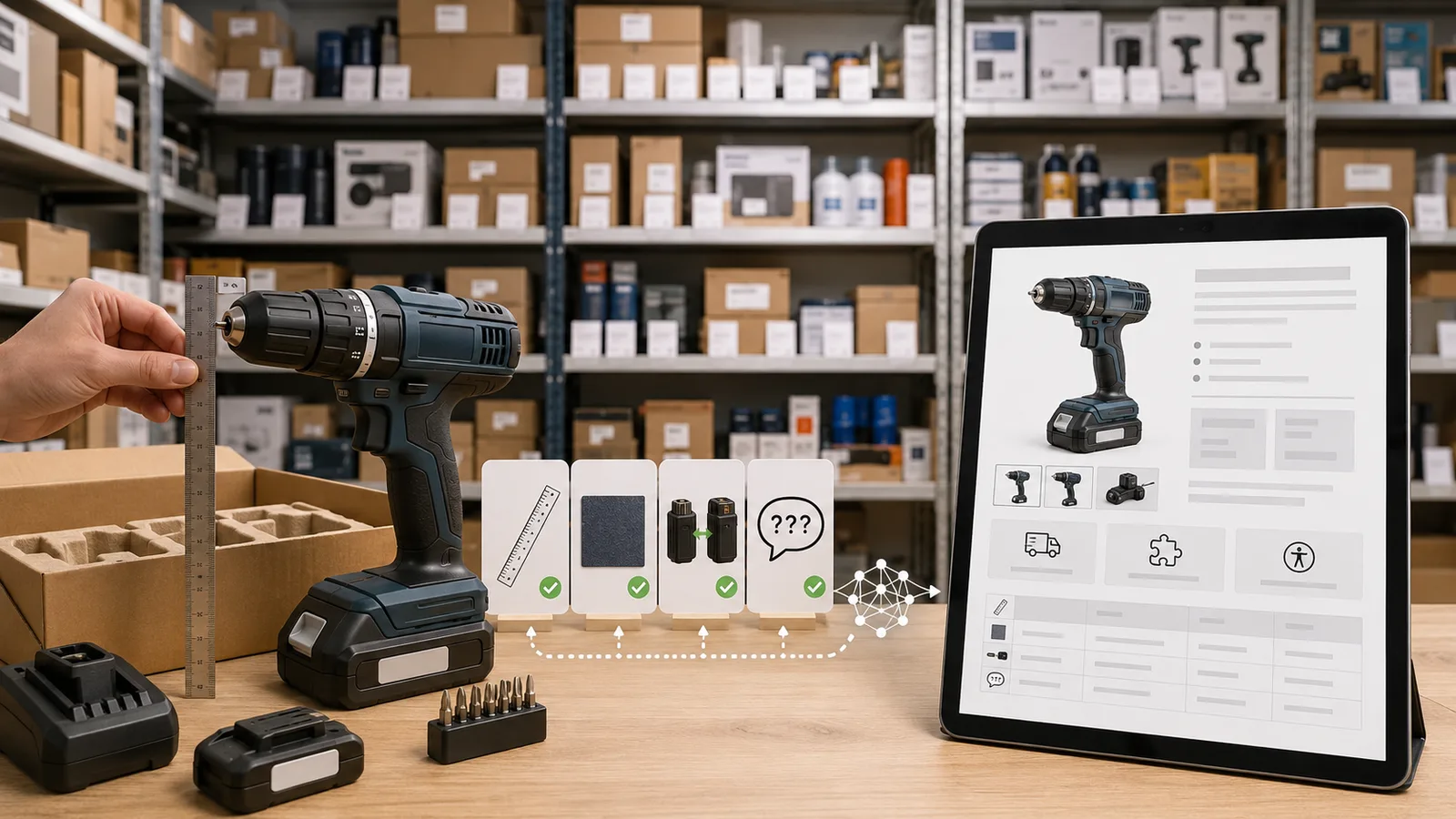
An instruction like "write a compelling description for this product" produces exactly what it was given: nothing. What you need to supply, per product:
- the real specifications — dimensions, material, compatibilities, what is in the box;
- who it is for, in one line, and who it is not for;
- the three questions customer service receives most often about this product;
- what distinguishes it from the one next to it in your own catalogue.
Point 3 is the one people skip and it is the most profitable: your customer questions are a seam of content already validated by demand. Nobody has to guess what the buyer wants to know — they already asked, in writing, dozens of times.
3. Processing order, by return
Across a whole catalogue not everything is equal. Work in this order:
- products already getting traffic but converting poorly — demand exists, it is the page that fails;
- missing alt text, across the whole catalogue — mechanical, fast, and immediately useful;
- descriptions strictly identical to the supplier's, starting with your best sellers;
- structured data, once, at template level — not product by product;
- the rest of the catalogue, by revenue order.
⚠ Do not start with the rest of the catalogue. It is the largest volume, the lowest return, and it is where the energy runs out before you have touched what pays.
4. The four things never to generate unreviewed
This section is the most important in the article, and it is short.
Numeric specifications. Dimensions, weight, power, capacity, compatibilities. A model produces a plausible number when it does not know one, and a plausible-but-wrong number on a product page is a commercial and sometimes legal error. These values get copied from your source; they do not get written.
Regulated claims. Health, safety, environment, origin, compliance. These statements are governed; a phrasing that "sounds right" binds you.
Prices and promotions. Never in free text: they live in the fields built for them, otherwise they go wrong at the first discount and nobody notices.
Customer reviews. You do not generate a review. It is not a quality question, it is an honesty question — and it is also the most documented founding case in our own history: a rating displayed without a single real customer.
5. Verify it worked — three measurements, not an impression
A rewritten catalogue that "seems better" is not a result. Three readings, before and at thirty days:
- the add-to-cart rate of reworked pages, compared with unworked pages over the same period — that is the witness that neutralises seasonality;
- the number of customer questions about reworked products: if it drops, the page answers better, and you have gained support time on top of sales;
- search impressions on those pages, at three months — search moves slowly, do not judge it at three weeks.
If none of the three moves, the page was not the problem: look at the price, the photo, or the product itself.
Conclusion
Optimising product pages with AI is not about generating text: it is about applying three hundred times what you already know about your products, and never letting the machine invent what it cannot know.
The rule that summarises the rest: supply material, not adjectives. A description written from real specifications, real customer questions and real product limitations is immediately distinguishable from one written from an instruction — including to a reader who could not say why.
And the question to ask before launching the whole catalogue: could I answer those four points for my ten best sellers? If not, start there — it is product-knowledge work, and no tool does it for you.
Next: boosting WooCommerce sales with AI, abandoned cart recovery, and the native AI approach to SEO. On the tooling side: Boost for WooCommerce and the alt text generator — premium versions with a full refund within 14 days.